Showing posts sorted by date for query caesar. Sort by relevance Show all posts

Tuesday, September 07, 2010

CAMWS Latin Translation Contest 2010-2011

The Classical Association of the Middle West and South Latin Translation Contest 2010-2011 is a competition open to advanced Latin students anywhere in the United States and Canada, who are either enrolled in secondary schools or attending homeschool. The contest is intended for students with at least three years of Latin, but superior second-year students are also eligible to participate.

Students must show an affiliation to CAMWS in one of three ways:
  1. Their teachers must be individual members of CAMWS
  2. OR their schools must be institutional members of CAMWS
  3. OR their school libraries must subscribe to The Classical Journal.
Teachers should note that the examination must be administered by a school official other than the Latin teacher during the week of November 29-December 3, 2010. Deadline for registration is November 5, 2010.

The Translation Contest consists of a one-hour examination with an annual alternation of Prose and Poetry. This year's contest consists of a Latin Prose selection, as exemplified by Caesar, Cicero, et al. According to the contest rules, students should translate as literally as possible without violating English idiom and they should know the relevant vocabulary presented in Colby's Latin Word Lists. (A copy of the list is available to all contestants FREE upon request when registering!)

Writers of the ten most outstanding papers written will receive a $250 cash prize. An additional twenty outstanding contestants will receive a book prize relevant to classical antiquity. Meritorious examinations will receive letters of commendation.

There is a $2 non-refundable fee for each contestant entered.

To view copies of the most recent prose exams, you may visit CAMWS. You may also view a list of previous winners.

For more information, please contact: Robert White c/o Shaker Heights High School, 15811 Aldersyde Drive, Shaker Heights OH, 44120-2505, Tel. (216) 295-4200.


Monday, September 06, 2010

New Advanced Placement Latin Resource for Caesar

Christopher Francese, a professor in the Department of Classical Studies, Dickinson College, and a student helper have created a wiki-based commentary on the AP Caesar Latin selections. Based on older school editions, it also includes some digital enhancements (some vocabulary and mp3 audio, maps and tools).

Tuesday, March 16, 2010

Latin in the News

It's March and so it's not surprising to see a lot of stories about the Latin language in the news. We have just commemorated the Ides of March (which took place on March 15) and we're gearing up for Rome's birthday on April 21st.

Here's a round-up of recent news stories:

Australian students compete in European CICERO Latin Competition
North Shore Times

March 16, 2010

Taunton Daily Gazette
March
15, 2010

Latin teacher Pamela Koleszar takes proactive measures to keep her Latin program active.
Evansville Courier and Press
March 16, 2010

Interview with the Colorado Intermediate Level Latin Speaker Film Contest Winner
The Daily Camera
March 13, 2010


Wednesday, October 28, 2009

Legible Latin

Legible Latin is a Latin dictionary and text reader software package written by Thomas McCarthy and available from Perlingua Language Tools. With it, you can analyze text for reading. Seven well-known texts come with Legible Latin (Caesar, Cicero, Sallust, Vergil, Livy, the Gospels and the Gesta Romanorum) or you can paste in your own text or retrieve it from an online source. The program also includes a "macronizer" for adding macrons to Latin text. The dictionary utilized by Legible Latin is based upon Whitaker's Words, but you can also look up words through the program's interface with dictionaries on the internet (via the Perseus Project or a dictionary of your own choosing). Legible Latin is free and comes in all three flavors, Windows/Mac/Linux. Legible Latin is produced by the same company that brought you SightWords.

Wednesday, September 09, 2009

Dickinson Summer 2010 Workshop

Summer 2009 is over and it's time to think about what you'll be doing in Summer 2010!

The Dickinson Summer 2010 Workshop

Participants will read selections from De orbe novo by the Italian humanist Peter Martyr of Angleria (1457-1526), the most important early account of Columbus' voyages to the new world. This work was originally written in Latin, and was complete by 1501. Martyr did not travel to the new world himself, but did interview Columbus and his shipmates, as well as other players in the events. His Latin is not difficult, and the spare and straightforward style of this work could best be compared among classical works to Caesar's commentaries.

Given the topic this year, a special invitation is extended to teachers and scholars interested in early contacts between Europe and the Americas who would like to read De Orbe Novo in the original.

INSTRUCTORS: Prof. Christopher Francese and Prof. Meghan Reedy, both of the Dickinson College Department of Classical Studies

TO APPLY: please contact Mrs. Barbara McDonald (see contact information at http://latincamp.wetpaint.com/) by the application deadline May 1, 2010.

FEE: The fee for 2010 is $300, due in a check made out to Dickinson College, by the fee deadline June 1, 2010. Please send it to Mrs. Barbara McDonald, Department of Classical Studies, Dickinson College, Carlisle, PA 17013. (The full cost is about twice that, but the workshop is subsidized by the Roberts Fund for Classical Studies.)

MORE INFORMATION: http://latincamp.wetpaint.com/

Sunday, June 28, 2009

Latin With No Dictionaries?

Many intermediate and even advancing Latin readers often find that the greatest obstacle to reading Latin in a linear word order is vocabulary. NoDictionaries.com can help! This is a specialized dictionary engine which prepares a running vocabulary list for any Latin text that you type in. It won't do all the work of reading or translating for you, but it can make the experience more pleasant by helping you reduce the amount of flipping you do through the pages of your Latin dictionary. The author of NoDictionaries.com has provided many Latin authors already prepared for you to download and read!

If you join, you can create a running vocabulary study sheet for the books or text that you are reading. (Those of you who are preparing for the Advanced Placement Caesar and Vergil exam may find this feature particularly helpful! A number of books from De Bello Gallico (no word yet if that's the selected text, though) and Vergil's Aeneid have already been processed on the site.)

Do be sure to take a look at Laura Gibb's helpful notes for using NoDictionaries.com first. She clearly explains a lot of the features in detail.

Other helpful dictionary reference tools to help save you time and read more Latin include:

The Perseus Project: Charlton T. Lewis and and Charles Short's A Latin Dictionary. This authoritative resource provides very detailed definitions and citations from Classical Latin authors showing each word used in context. Also available at the Perseus Project is Charlton T. Lewis' An Elementary Latin Dictionary, which is ironically shorter than the Lewis and Short version.

Available on the iPhone and iPod Touch App Store are two Latin dictionaries for download: Latin Dictionary and Lexidium. These are easily found if you have an iPhone or iPod Touch. Simply click on the App Store icon and do a keyword search for the titles.

Tuesday, June 16, 2009

Some Advice on Teaching Caesar

Professor William Harris, late of Middlebury College, wrote a short essay Gaius Julius Caesar that is well worth spending some time reading. Professor Harris provides some background relating how he believes Caesar's Gallic Wars came to be the "sine qua non" upon which Latin studies were based in the U.S. in the 19th century. He also gives some advice regarding teaching the content of De Bello Gallico, as well as the technicalities of Caesarian grammar.

At the same site, also see A Note on Caesar as Stylist.

Thursday, June 11, 2009

Caesar Tweets!

Would you believe that IVLIVSCAESAR has a Twitter stream? (Okay, it's actually Laura Gibbs of the Bestiara Latin Blog. The "tweets" are based upon Plutarch's Life of Caesar.)

Objections to Caesar from the Past

Some may question whether Caesar is too easy for the AP Latin Literature course.

Throughout the 2oth century, many second year Latin books based their content upon Caesar's Gallic Wars. It is clear that for over a century, Latin teachers and professors have dealt with the question of the place of Caesar's writings in the Latin curriculum.

As early as 1916, Josiah Bethea Game wrote in Teaching High School Latin: "Classes are often not ready for Caesar at the opening of the second year...Caesar is more difficult Latin than its place in the course of study would indicate...It really ought to be given in the third year, for it is the rock on which unnumbered thousands of faithful pupils have gone to pieces utterly." (p. 76)

Moving Caesar to Advanced Placement status may at least allow teachers to finally admit that Caesar is actually quite difficult for second year students.

Another criticism of Caesar is that his material is actually fairly dry and dull.

Game spends most of his time in the chapter discussing second year Latin on how to teach Caesar effectively, admitting that "if you work under a course of study which absolutely fixes the work in Caesar, you will of course be forced to do the best you can." He notes that students don't usually learn much about Roman civilization in a Caesar course and that it is imperative that they spend time reading something other than Caesar or they may end up "feeling that Latin is of limited value." He strongly suggests that students prepare contextual themes to present to the class in order to provide coherence to the course.

Charles Bennett (perhaps the greatest champion of the grammar-based philosophy of teaching Latin) even conceded the weaknesses of Caesar while continuing to support his placement in the curriculum.

He enumerates several objections to Caesar (and especially De Bello Gallico) in The Teaching of Latin and Greek in the Secondary School (1911): "a) Caesar is undeniably difficult...b) Caesar is not interesting," and "c) the bearing of Caesar's narrative is not obvious," (pp. 112-113) summing it all up thus: "Caesar...is regarded by many as unique in its combination of difficulty, its dullness and its dearth of information." However, Bennett ultimately concludes that there is value in reading Caesar's Latin for his "purity of diction" and "accuracy of style" (p. 114.)

Non amo te, Caesar mi...

With permission from Professor Richard A. LaFleur of the University of Georgia, this seems to sum up the reaction of many secondary school Latin teachers to the announcement that Caesar will replace Cicero, Ovid, Catullus and Horace on the AP Latin Lit exam:

"..cum apologiis Martiali carissimo nostro (not least for the metrical fudge in "Caesar"--let's just call that a "systole"):

'Non amo te, Caesar mi; nec possum dicere quare.
Hoc tantum possum dicere: non amo te!'"

Translation: "With apologies to our most dear Martial...'I do not love you, my Caesar; I can't say why. I am only able to say this: I don't love you.'"

(Based upon Martial I, 32: "Non amo te, Sabidi; nec possum dicere quare. Hoc tantum possum dicere: non amo te!")

Julius Caesar Vicit!

Venit, vidit, vicit! (He came, he saw, he conquered!)

Dust off your copies of De Bello Gallico and/or De Bello Civili! (No word yet as to which of Caesar's commentaries.)

According to a recent post to the AP-Latin discussion list, the Advanced Placement Latin Development Committee has announced its plan to create a new two-author AP poetry and prose Latin Literature course. Vergil's Aeneid will remain on the syllabus, but apparently the required number of lines will be reduced. The new prose author will be Caesar.

(The previous syllabus included the poets Ovid, Catullus, Horace and the prose author Cicero in various combinations, in addition to the Vergil exam. The Ovid/Catullus/Horace/Cicero syllabus was discontinued earlier this year.)

Caesar is generally read before Vergil, and was traditionally taught in the second semester of the second year in American high schools especially during the mid-20th century. The Classical Investigation of 1924 prescribed the Caesar-Cicero-Vergil sequence. Many 21st century Latin teachers have preferred not to teach Caesar, for various reasons and many modern textbook series generally don't include very much of his writing. (Caesar tends to show up more often in grammar-based textbook series.) Some object to his focus upon war. Others find him boring. Many believe that Caesar is especially unappealing to their female students. On the other hand, Caesar's writings are definitely easier to read than Cicero's and many introductory prose composition and English-to-Latin translation courses have been based on Caesar. Teachers who want to promote spoken Latin in the classroom may find it easier to discuss Caesar's works in Latin than Cicero's. (Caesar's commentaries resemble "blog posts" from the front, while Cicero's orations often employ many rhetorical devices within a complicated sentence structure.)

Alea iacta est! (The die is cast.) Here are some resources for the teaching of Caesar for those of you who want to get a head start.

Also, check out T.J. Howell's Caesar Classroom resource for some imaginative ideas.

Macquarie University in Australia hosts an outstanding numismatic site, The Coinage of Julius Caesar.

See previous Latinteach blog entries referring to Caesar.

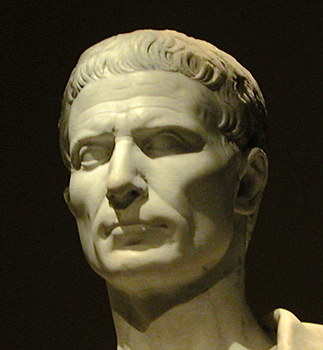
Statue of Caesar Courtesy VRoma.org

Sunday, March 15, 2009

The Ides of the Rest of the Months

National Public Radio (NPR.org) is very good about remembering the Ides of March. This year, they ask the question why we never hear about the Ides of any other month...though listeners wondered if the question was answered sufficiently as the expert consulted mistakenly identifies the Ides as occuring on the 15th day of each month. (Edited to add: As it turns out, the expert did discuss how the Ides can be on either the 13th or 15th, but that part ended up "on the cutting room floor" and not in the portion that was broadcast on air.)

The Romans expressed their dates using the Kalends, Nones and Ides. The first day of each month was called the Kalend. In March, July, October and May, the seventh day was called the Nonae and the fifteenth, the Idus. In other months, the Nonae fell on the fifth day, the Idus on the thirteenth. To give dates, the Romans would count backward from these dates. Most Latin grammars (George Lane; Gildersleeve and Lodge; Charles Bennett) include a section on Roman calendar dating. To find out how the Romans would express a date that didn't fall on a Kalend, Nonae or Idus, consult one of these aforementioned reference grammars for more information. It's a bit complex, but not impossible to understand, and these grammars often include quick reference charts for determining dates. The point here is, however, that the Ides don't always fall on the fifteenth.

According to this rhyme from the 19th century grammarians Basil L. Gildersleeve and Gonzalez Lodge:

"In March, July, October, May,

The Ides are on the fifteenth day,
The Nones the seventh; but all besides
Have two days less for Nones and Ides."

Listen to Beware: It's the Ides of March on Npr.org to see what you think.

Since it's the Ides of March, and we're still thinking about Caesar and calendars, it's also worth mentioning that Caesar reformed the Roman calendar, by fixing the number of days in a year at 365, adding a leap day every four years. The Julian Calendar (named, of course, for Julius Caesar) was eventually itself reformed by Pope Gregory XIII in the 15th century. The calendar we use today is called the Gregorian Calendar.

Click here for links to previous NPR radio presentations referencing the Ides of March.

If you have a blog, you can add a Roman calendar to it. Visit Laura Gibb's Schoolhouse Widgets for details.

Monday, March 09, 2009

Recreate Caesar's Legion in Your Classroom!

T.J. Howell has some imaginative suggestions for teaching Caesar, including setting up seating charts to resemble Roman battle lines! There are also suggestions for bulletin boards and props, as well as a bibliography. T.J. has also written two lesson plans, based upon Caesar's Gallic Wars: Decision at Alesia, which explores Caesar's perspectives of the motivations of the Gauls; and Roman Heroics, which is based upon Caesar's only campaign in Gaul that fails.

Remember, the Ides of March are approaching! See past blog entries keyed to Caesar for some interesting resources.

Thursday, January 01, 2009

Happy New Year!

Novum Annum Laetum Omnibus Exopto!

(Happy New Year, Everyone!)

Ianuarius is the first month of our year, but the ancient Romans originally celebrated the New Year in March. In 153 B.C., they decided to move the beginning of the year to January because that was the month in which the consuls, their leaders, took office. Of course, on January 20th, our new President-elect, Barack Obama, will take the oath of office.

According to Murray's Manual of Mythology, Ianuarius was named for the ancient god Ianus, because "the beginning of everything was a matter of great importance to them, and Ianus was the god of a 'good beginning.'" Accordingly, the first day of January was an major holiday for the Romans.

The gates of temple which the Romans built in honor of Ianus held deep significance to his worshippers. The gates stood open when Rome was at war and were closed only in times of peace. There were only three times in the first 700 years that temple gates were closed: during the reign of Numa Pompilius, after the first Punic War, and during the reign of Augustus Caesar.

At first, the Roman year had only ten months, but this didn't work out too well with the solar calendar. In 46 BC, Julius Caesar added two new months. He named one after himself, Iulius. The other new month was eventually named for the previously mentioned Augustus. The full list of the months (menses) of the year (annus) in Latin are as follows: Ianuarius, Februarius, Martius, Aprilis, Maius, Iunius, Iulius, Augustus, September, October, November, December.

To find out more about how the Ancient Romans celebrated the New Year, here's a classic NPR.org feature Roman New Year.

Wednesday, December 17, 2008

The Playmobil Romans Know Latin!

Our Playmobil Roman Arena set arrived! We bought the smaller set and decided to get some extra Roman soldiers nd gladiators to go along with it. Plus the Roman family, which we will name Caecilius, Metella, Quintus and Caecilia.

While wrapping the arena to put under the Christmas tree, we realized that the parchment that the Caesar character holds has some actual Latin on it. It's a list of Latin maxims including "Alea iacta est," "Dum spiro, spero," "In hoc signo, vinces," "Repetitio est mater studiorum," "Primus inter pares," "Fiat lux," "Quod erat demonstrandum," "De gustibus non est disputandum," and several others.

Very, very cool! Excellent attention to detail!

Wednesday, October 29, 2008

Need Some Halloween Ideas for Your Latin Classes?

In addition to last year's Halloween ideas for Latin classes, here are a few more...

You might consider exploring the Latin of Harry Potter. Ginny Lindzey shows the Classical connection in Just Charming: Tapping into the Latin Magic of Harry Potter.

Michael Myer, Magister Lingua Latinae at Heathwood Hall Episcopal School, has some fun materials to share with you on his class website, including a list of the parts of the body (Partes Corporis) that can be used for playing Simon (or Caesar) Says, plus the lyrics to Illa Ossa (sung to the tune of 'Dem Bones').

For those of you who use Professor John Traupman's Latin Is Fun, Book 1 as a textbook or supplement, there is a scary Monstrum in Chapter 12 as well as a wonderful skit about the legendary Roman scientist Dr. Franciscus Frankenpetrus.
Dr. Melissa Schons Bishop has organized a Halloween activity kit which can be purchased at her new store, Creative Classical Curriculum. With up to three days of material for each class, "Horrible Haunted Halloween Horror" includes readings and activities for all four levels of Latin based upon authentic Latin texts: a haunted house story by Pliny for Latin I, the werewolf story from Petronius for Latin II, Lycaeon's metamorphosis into a wolf from Ovid for Latin III and Aeneas descent into the Underworld from the Aeneid for Latin IV. Each selection is accompanied by magic vocabulary lists and active learning followups. Dr. Bishop also includes two complete games Monster Bingus and the Underworld Game. The kit may be downloaded for $40 -- keep in mind that it can printed out and used for years. Also available and suitable for Halloween is "Gross Roman Facts."

Sunday, October 12, 2008

Latin Still Lives at the New York Times

In this weekend's New York Times, Maureen Down asks "Are We Rome? Tu Betchus!" She seems to be saying "Gratias tibi ago, sed non gratias tibi ago" to the self-indulgence of the past decade and invokes somber and serious Stoicism. Maureen Dowd Latinam amat, so she asked Gary D. Farney to translate her editorializing about our current situation, "The Battle of Gall" (a pun on Caesar's Gaul, of course) into Latin.

Wednesday, September 03, 2008

Sarah Palin and the Art of Rhetoric

Vice Presidential candidate Sarah Palin showed off her own keen oratorical skills this evening at the G.O.P. convention. Like Democrat President Clinton, she demonstrated that Republicans also know the value of a well-timed turn of phrase, working in a nice chiasmus -- an artful use of interlocking word order -- into tonight's acceptance speech: "In politics, there are some candidates who use change to promote their careers. And then there are those, like John McCain, who use their careers to promote change."

The presidential election season is always a wonderful opportunity to examine the speeches of politicians and how they use language artfully to persuade and sway the electorate. A great place to start is Silva Rhetoricae, a site dedicated to the study of Classical and Renaissance rhetoric. There's also a much briefer, but still useful Glossary of Rhetorical Terms maintained by the University of Kentucky Classic Department.

Those of you who are reading and studying great Classical authors, speakers and poets may want to consider how the figures of speech used by the likes of Caesar, Cicero and Vergil are imitated by modern politicians and activists to evoke emotional responses and persuade people to action.

Saturday, August 09, 2008

Render Unto Caesar, That Which is Caesar's...

Dexter Hoyos passes along the word that there is a new website dedicated to telling the life of Julius Caesar through coins. Designed and maintained by the Australian Centre for Ancient Numismatic Studies at Macquarie University, Sydney, The Coinage of Julius Caesar is a unique biographical look at the his life, accomplishments, and legacy. There are numerous high quality clickable photographs of coins and viewers can examine both obverse and reverse images via a mouseover. Major highlights include the early career of Julius Caesar, the Gallic and Civil Wars, portraits of Caesar, as well as the influence of the first Caesar upon the coinage of his successors.

A bibliography, glossary and reference catalogue accompany the main site.

This is a particularly interesting site for anyone reading Caesar's De Bello Gallico or De Bello Civili, as well as students of Roman history or ancient numismatics (the study of coins.)

Sunday, March 16, 2008

Better Late Than Never! Beware the Ides!

This should have been posted earlier, but the Ides fell on a Saturday this year. Oh well, better late than never...

As most of you undoubtedly already know, according to the Roman calendar, the Ides take place every month on either the 15th (March, May, July and October) or the 13th (all others). The Ides of March are the most famous Ides because Julius Caesar was assassinated on the 15th of March, 44 BC.

National Public Radio seems to take the Ides of March pretty seriously, because they have quite a few streaming audio clips in their archives commemorating Caesar's demise.

From the BBC comes lesson plans for Sixty Second Shakespeare and a page from the Sixty Second Times outlining the events of the day!

Enjoy!

Photo courtesy of the Vroma Image Archive