Showing posts with label Roman history. Show all posts
Showing posts with label Roman history. Show all posts
Tuesday, March 16, 2010
Hadrian's Wall Illuminated in a "Line of Light"
Over 1000 volunteers lit beacons along Hadrian's Wall to celebrate British Tourism Week. You can see a video and read the story at the BBC News website: "Volunteers Illuminate Hadrian's Wall 'Line of Light."


Tuesday, October 13, 2009
The Saturnalia Solution
A columnist for the Bangor Daily News advises recent graduates and other job seekers to keep a positive attitude during their search for employment, explaining how "[getting] a grip on a little ancient history" can help them feel less alone and more upbeat about their plight. Read "Jobless? Party in the Spirit of Rome" (10 October 2009) by Rosemary Herbert.
Wednesday, October 07, 2009
Math, Science, History and Latin connection
Science Daily is reporting that "buried coins may hold key to solving mystery of ancient Roman population." (6 October 2009) In a fascinating story, a biologist and a historian have concluded that ancient Rome was not as populated as previously believed. Read the article at Science Daily to see this fascinating connection between mathematics, science, numismatic history and Latin.
Tuesday, September 15, 2009
Ancient Rome and America Exhibit, Philadelphia Spring 2010
If you will be anywhere near Philadelphia in Spring 2010, make plans to visit the National Constitution Center. As part of its focus upon "important moments and iconic figures that changed history," the National Constitution Center will be presenting an exhibit entitled Ancient Rome and America in Spring 2010. According to the Center's press release, this will be a 6,000 square foot exhibition and will include a large number of artifacts from the Republican and Imperial periods. Connections will be made between the founding fathers of the American government and the Roman Republic, as well as the continuing influence of the Romans upon our modern world.
Sunday, September 06, 2009
Classical Literacy Exam
News of a new competition, the Classical Literacy Exam, sponsored by the Albuquerque Academy Latin Honor Society, was recently carried in Torch, the official quarterly magazine of the National Junior Classical League. The Classical Literacy Exam is open to students everywhere and will require no specialized knowledge of the Latin language. Exam topics include Classical mythology, history, culture, some vocabulary derivatives, Latin phrases and abbreviations, and literature. The main emphasis is on Roman civilization, but there will be a few questions about Greek civilization and culture (eg. terms such as agora, Parthenon, and Acropolis on Level I and some brief philosophical references on Level II and III.)
According to Hugh Himwich, who is directing this new initiative, the guiding principle is "to include everything that an educated person should know about the Classical world, even if they unfortunately have never had a Latin class." Of course, if they have studied Latin, "the CLE will be a reward and a delight." There are three levels to the examination.
Contact the exam sponsor to be put on the mailing list to receive an application and study guide. The target for administering the exam is the first week in February (but there is some flexibility for schools that need an alternative date.) Award certificates will be sent in March as well as school book awards for outstanding participation and achievement.
Teachers will grade their own tests and send the results to the CLE headquarters.
According to the advertisement in the Torch, the cost for the exam is fifty cents per student. The format is fill-in-the-blank with the term that matches the definition. The application deadline is January 15, 2010.
The Classical Literacy Exam website is currently under construction and more information is forthcoming soon, so keep checking back for complete details to be posted in the next few weeks.
Monday, July 13, 2009
Two Upcoming Webinars for Latin and Classics Teachers
"TEACHING LATIN TO YOUNG CHILDREN" WEBINAR
Rose Williams will be leading a webinar in Bolchazy-Carducci's summer series for Latin teachers on July 16th, 6-8PM Eastern: "Making Room for History in a Busy Latin Class". Rose will give a brief overview of Roman history for use very early in the first term which can be used as an outline for the overall study of Latin. Various historical materials that can be woven into your lesson plans will be presented.
Webinar attendees may submit questions and suggestions in advance of the session, and will be asked to submit ideas for using these materials in their respective teaching situations after the seminar. Before the webinar beings, each participant should search his/her text or teaching plan for advantageous areas for integrating history materials.
If you would like to attend, please RSVP to info@bolchazy.com or register online at http://www.bolchazy.com/webinars.html. There is a $99.00 charge for the two-hour,live session. By participating in this session, you may qualify for professional development credits.
Barbara Bell, the acclaimed British author of the popular children's Latin series Minimus, has been named to the 2009 Queen's Birthday Honours List for "those who have gone the extra mile to make a difference to the lives of people around them." Bell received her MBE for her work as "a classics teacher at Clifton High School in Bristol, who has raised the profile of the subject and increased its accessibility."
Barbara Bell will be visiting the USA in July and you have the opportunity to meet her, even if you can't make it to any of the cities that she will be visiting! Barbara will will be participating in a free online webinar on July 14th. To register, please visit Cambridge's US website for complete details on how to participate:
JULY 16, 2009
ROSE WILLIAMS "MAKING ROOM FOR HISTORY IN A BUSY LATIN CLASS
Webinar attendees may submit questions and suggestions in advance of the session, and will be asked to submit ideas for using these materials in their respective teaching situations after the seminar. Before the webinar beings, each participant should search his/her text or teaching plan for advantageous areas for integrating history materials.
If you would like to attend, please RSVP to info@bolchazy.com or register online at http://www.bolchazy.com/webinars.html. There is a $99.00 charge for the two-hour,live session. By participating in this session, you may qualify for professional development credits.
Monday, May 25, 2009
Memorial Day
Christopher Francese, Associate Professor of Classical Studies at the highly-regarded Dickinson College, has a wonderful Latin Poetry Podcast that is well worth downloading from iTunes! You can also listen online at the Dickinson College Blog.
In March 2008, Professor Francese read an Epitaph for a Roman Soldier (CLE 537 = CIL 5.5824), which is the lament of a mother for her fallen son, a soldier who died far from home without a proper burial.
Today, on this Memorial Day, let us all remember the American airmen, soldiers and sailors who have died for our freedom, as well as their families.
Tuesday, April 21, 2009
Felicem Natalem Diem, Urbs Roma!
Today is Rome's birthday. The traditional date of the founding of the eternal city is April 21, 753 B.C. and it is from this day (A.U.C. or ab urbe condita, translated "from the founding of the city") that Romans expressed their history in relation to the Roman Era. April 21st was also known as the Parilia (or Palilia), the festival that the Romans considered sacred to shepherds. Romulus and Remus, credited with the founding of Rome, were the foster sons of the shepherd Faustulus. They were considered to be the biological sons of the Roman god Mars. The story of the birth of Romulus and Remus as well as the founding of the city is told by the Roman historian Livy. The modern Latin writer, Lhomond, who wrote in the late 1700s retells the story in easier Latin in his book De Viris Illustribus Urbis Romae A Romulo ad Augustum.
Kentucky Educational Television has some activities for teachers and students who would like to celebrate Rome's birthday. Scroll down the page to find some suggestions, including raking campus grounds and planting a tree (perhaps coinciding with tomorrow's Earth Day), then celebrating with a feast! KET has a birthday song you might sing in Latin too! There are some other ideas there you might use throughout the week, as April had many holidays sacred to the Romans.
Charlotte Yonge, a Victorian author from England who wrote for children , tells the story of The Founding of Rome at Project Gutenberg.
Kentucky Educational Television has some activities for teachers and students who would like to celebrate Rome's birthday. Scroll down the page to find some suggestions, including raking campus grounds and planting a tree (perhaps coinciding with tomorrow's Earth Day), then celebrating with a feast! KET has a birthday song you might sing in Latin too! There are some other ideas there you might use throughout the week, as April had many holidays sacred to the Romans.
Charlotte Yonge, a Victorian author from England who wrote for children , tells the story of The Founding of Rome at Project Gutenberg.
Tuesday, January 13, 2009
Inauguration Day Approaches
On January 20th, Inauguration Day, President-elect Barack Obama will take the oath of office and become the 44th president of the United States.
The Romans did not elect presidents, but citizens did vote at times during their history.
From 753 B.C. to 510 B.C., Rome was a monarchy. There were seven kings of Rome: Romulus, Numa Pompilius, Tullius Hostilius, Ancus Marcus, L. Tarquinius Priscus, Servius Tullius, and L. Tarquinius Superbus. The Romans grew tired of their kings and overthrew Tarquinius Superbus (otherwise known as "Tarquin the Proud.") As the Romans were wary of once again concentrating too much power in the hands of one person, they agreed to name two consuls, elected to one year terms. In times of war, if the consuls could not agree, there was provision for a single-man dictatorship. This emergency power was limited to six months only.
Rome was considered a Republic from 509 B.C. to 27 B.C.
According to William Smith, in his School Dictionary of Greek and Roman Antiquities, the consuls originally began their duties in October. The official inauguration date was then moved to different times of the year (August, then the Ides of December, often the Ides of March) until finally in 153 B.C., the Romans settled on January and this month remained permanent until the end of the Republic.
Smith points out some features of the Roman inauguration celebration. There was a parade of the senators, knights and citizens from the home of the consuls to the capitol. The consuls offered up sacrifices and then went to the Curia, the place where the Senate met, where each gave a speech about matters important to the Republic. The consuls took a solemn oath and promised to keep the law of the Republic. There was typically a banquet, to which the new leaders invited friends and colleagues.
In 27 B.C., the Augustan Age began and Rome became an empire. The Roman Empire lasted until around 535 B.C.
The Romans did not elect presidents, but citizens did vote at times during their history.
From 753 B.C. to 510 B.C., Rome was a monarchy. There were seven kings of Rome: Romulus, Numa Pompilius, Tullius Hostilius, Ancus Marcus, L. Tarquinius Priscus, Servius Tullius, and L. Tarquinius Superbus. The Romans grew tired of their kings and overthrew Tarquinius Superbus (otherwise known as "Tarquin the Proud.") As the Romans were wary of once again concentrating too much power in the hands of one person, they agreed to name two consuls, elected to one year terms. In times of war, if the consuls could not agree, there was provision for a single-man dictatorship. This emergency power was limited to six months only.
Rome was considered a Republic from 509 B.C. to 27 B.C.
According to William Smith, in his School Dictionary of Greek and Roman Antiquities, the consuls originally began their duties in October. The official inauguration date was then moved to different times of the year (August, then the Ides of December, often the Ides of March) until finally in 153 B.C., the Romans settled on January and this month remained permanent until the end of the Republic.
Smith points out some features of the Roman inauguration celebration. There was a parade of the senators, knights and citizens from the home of the consuls to the capitol. The consuls offered up sacrifices and then went to the Curia, the place where the Senate met, where each gave a speech about matters important to the Republic. The consuls took a solemn oath and promised to keep the law of the Republic. There was typically a banquet, to which the new leaders invited friends and colleagues.
In 27 B.C., the Augustan Age began and Rome became an empire. The Roman Empire lasted until around 535 B.C.
Saturday, May 17, 2008
Classics Freebies from the Open University!
The Open University is a distance learning university based in the United Kingdom which awards both undergraduate and postgraduate degrees to students around the world. The Open University also offers free non-credit mini-courses through it's Learning Space. Several courses look like they may be of interest to readers of this blog:
- Getting Started on Classical Latin For students who have no experience whatsoever with Latin. You'll develop "an awareness of the links between English and Latin, an understanding of basic English grammar...and an awareness of the fundamentals of pronunciation in Latin." There's also a similar Greek mini-course!
- Introducing the Classical World "aims to get you started on exploring the Classical World by introducing you to the sources upon which you can build your knowledge and understanding" as well as "getting you started on an exploration of both time and space in the Classical World."
- Exploring a Romano-African City investigates the archaeology and history of a Roman North African City. The learner will learn to identify both indigenous and Roman identity and culture and study the development of Romano-African culture.
- The Roman Empire: Introducing Some Key Terms is a course "introducing key terms that are essential for understanding the Classical Roman world."
Sunday, March 16, 2008
Better Late Than Never! Beware the Ides!
This should have been posted earlier, but the Ides fell on a Saturday this year. Oh well, better late than never...

As most of you undoubtedly already know, according to the Roman calendar, the Ides take place every month on either the 15th (March, May, July and October) or the 13th (all others). The Ides of March are the most famous Ides because Julius Caesar was assassinated on the 15th of March, 44 BC.
National Public Radio seems to take the Ides of March pretty seriously, because they have quite a few streaming audio clips in their archives commemorating Caesar's demise.
Enjoy!
Photo courtesy of the Vroma Image Archive
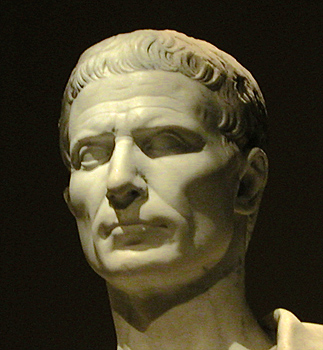
As most of you undoubtedly already know, according to the Roman calendar, the Ides take place every month on either the 15th (March, May, July and October) or the 13th (all others). The Ides of March are the most famous Ides because Julius Caesar was assassinated on the 15th of March, 44 BC.
National Public Radio seems to take the Ides of March pretty seriously, because they have quite a few streaming audio clips in their archives commemorating Caesar's demise.
- Ides of March After-Party: Roman Drinking Songs?
- Commemorate Caesar: Take a Deep Breath
- The Roots of Caesar Salad
- Brush Up Your Shakespeare
- Ides of March: A Condensed Version of Julius Caesar featuring Orson Welles, ca. 1938
Enjoy!
Photo courtesy of the Vroma Image Archive
Saturday, July 21, 2007
Teaching Roman History
The Romans is an outstanding free online resource based upon Antony Kamm's book, Introduction to the Romans, originally published by Routledge. Andrew Wilson, who also maintains the superb Classics Pages, did the work of transcribing and hyperlinking the pages. You may also recognize Andrew Wilson as the person who translated Harry Potter and the Philosopher's Stone into Ancient Greek!
The Romans website includes not only the text of the Kamm's book, but also photographs, original illustrations, timelines, and best of all, interactive activities and quizzes!
Subscribe to:
Posts (Atom)